tony
Week 51
25
3
Week 50
25
1
Week 44
25
2
Week 43
25
2
Week 42
25
2
Week 19
25
1
Week 41
24
2
Week 25
24
1
Week 20
24
2
Week 13
24
1
Week 11
24
1
Week 09
24
1
Week 08
24
1
Week 07
24
2
Week 06
24
1
Week 03
24
3
Week 02
24
4
Week 01
24
7
Week 52
23
7
Week 51
23
5
Week 50
23
7
Week 49
23
3
Week 48
23
4
Week 47
23
7
Week 46
23
9
Week 45
23
10
Week 44
23
7
Week 43
23
5
Week 42
23
7
Week 41
23
8
Week 40
23
10
Week 39
23
10
Week 38
23
22
Week 37
23
5
Week 36
23
1
Week 34
23
2
Week 32
23
1
Week 28
23
1
Week 25
23
1
Week 24
23
1
Week 21
23
2
Week 20
23
1
Week 19
23
3
Week 18
23
6
Week 17
23
1
Week 16
23
2
Week 15
23
5
Week 14
23
5
Week 13
23
1
Week 12
23
7
Week 11
23
10
Week 10
23
2
Week 09
23
1
Week 08
23
3
Week 07
23
2
Week 05
23
1
Week 04
23
3
Week 03
23
1
Week 02
23
1
Week 01
23
9
Week 52
22
5
Week 51
22
3
Week 50
22
17
Week 49
22
3
Week
44
Tonic
Nov 02
-
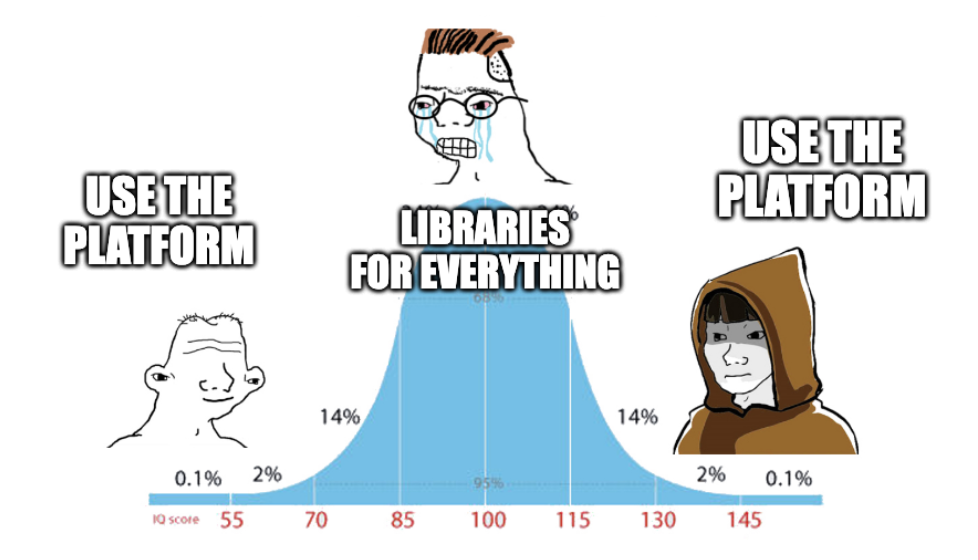
I started working with Rails 13 years ago (v 3.0), and have used it almost exclusively since then. In that time, I've easily worked on 50+ codebases in some form or another, and seen every library and pattern under the sun on small and large teams. What's remarkable is that, while Rails itself has changed a lot in that time (we're now at v 7), the underlying fundamentals of the web have changed remarkably little, and the approach I now follow for building apps with Rails would have been completely possible with the first version of Rails I learned, way back in 2010.
-
-
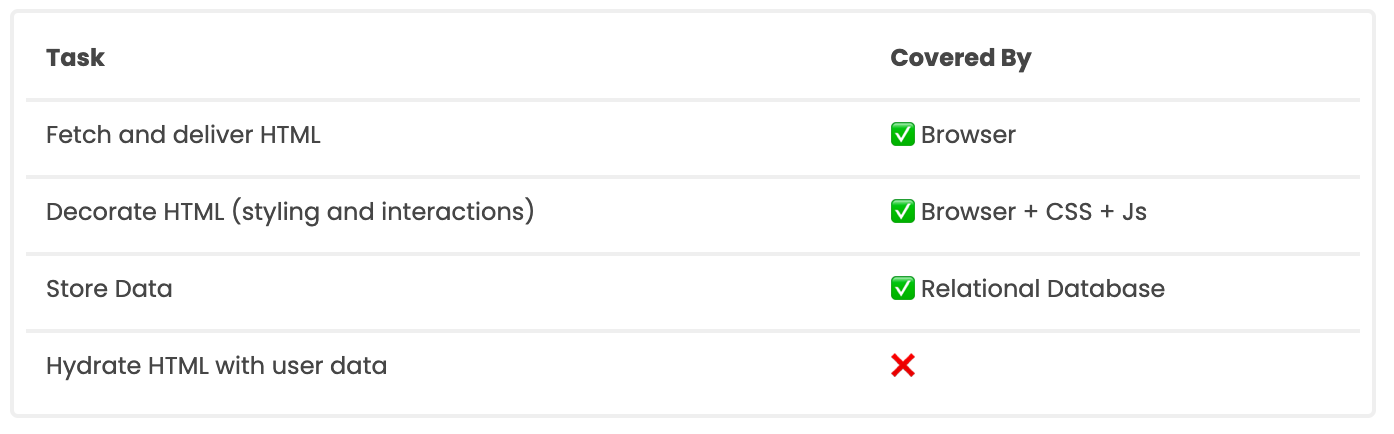
The crux of my approach is this: Web apps are built around HTML. Browsers are extremely good at fetching and displaying HTML - so that part is taken care of for us. Additionally, relational databases have been around for a very long time and do their job - storing and retrieving data - very well.
-
So without Rails, as programmers we already have out-of-the-box solutions for storing data, and for delivering HTML. What we don't have is a way to combine them both - to hydrate the HTML with specific data based on what user is requesting it.
-
-
HTML: the eighth wonder of the world
-
As demand for programmers seems to continuously exceed the supply, it's generally believed that in order to be a coder, one must be Very Smart™ . And yet HTML - the bedrock around which all of this software is built - is actually very approachable and easy to learn: So much so that children and adults can understand and learn the basics in a day. This is a remarkable fact.
-
As someone who's spent a lot of time dealing with the pain of finding and hiring software engineers, I've thought a lot about why it's so difficult. The result of that thinking can be boiled down to the following bullet points;
-
Holding that the only necessary complexity to building web software - beyond knowing How HTML Works and How Databases Work - is knowing how to hydrate html with the contents of a database, we can infer that the rest of the complexity is incidental complexity.
-
Most of the incidental complexity comes from 1. Tooling, and 2. Framework-specific concepts.
-
As a result, when hiring developers, the primary thing we're evaluating is their existing technical knowledge.
-
-
What if we think of Rails not as "Rails is a large framework for building complex web apps, whose libraries and patterns (hotwire, stimulus, turbo...) need to be studied", to "Rails is a way to access a collection of utilities that make it easier to work with HTML"
-
At this point I've worked with dozens of people using this approach, who had little to no prior rails experience, who were able to understand non-starter codebases after just a few hours. One exercise that helped was drafting up a cheat sheet with some of the most common code snippets. For people who have some web experience but no Rails experience, simply reading through this is a psychological-barrier-lowering exercise.
-
-
Rails (as an HTML Container) Cheat Sheet
-
A simple way to specify routes
-
# config/routes.rb Rails.application.routes.draw do get "/info" => "site#info", :as => "info" end -
<a href="<%= info_path %>">Build</a> -
A simple way to handle identity
-
gem 'devise' -
before_action :authorize_user! -
if user_signed_in? do_something end -
A set of simple helpers for building html templates
-
<div id="menu"> <%= render :partial => "common/menu" %> </div> -
A simple, secure way to work with a database
-
user = User.new user.first_name = "Tony" user.save user.valid? user.errors.full_messages -
people = User.where("location = ?","ireland").page(3) -
<%- @people.each do |person| %> <h1><%= person.first_name %></h1> <img src="<%= person.image.url %>"></img> <% end %> -
A simple way to access and use data submitted by forms
-
params[:first_name] -
The above code snippets cover a surprisingly large amount of the code that's needed to build simple software.
-
-
Further Implications
-
With the baseline approach of "Let's center html and minimise the learning curve of everything else", we also landed on a few more somewhat surprising conclusions. They became so long that we moved them into a separate post - Friendly Rails guidelines
-
-
Common Objections
-
Why go to all this trouble? Can't you just hire more experienced devs?
-
See my opinions on the very real and very painful developer hiring problem.
-
Ok so you made the codebase easier to work with. There's still a huge learning curve for the tooling and infrastructure
-
See our adventures in Remote Development, which totally remove a whole class of environment and infrastructure setup issues.
-
You said you don't use pre or post compilation, but you do use Tailwind. How is that so?
-
We created static-tailwind, which includes most of the utility with none of the compilation. There is a performance implication, so it doesn't work in all cases, but in most the hit is unnoticeable.
-
But the markup hurts my eyes
-
I feel you. If that's more important for you, then don't follow the advice in this article.
Tonic
Nov 02
-
Testing With Formatting
-
This is a paragraph that goes on for quite a while in which i talk about various different things, you know
-
This is a paragraph that goes on for quite a while in which i talk about various different other things that you may or may not find interesting
-
Few bullets
-
Super
-
-
This is another paragraph